
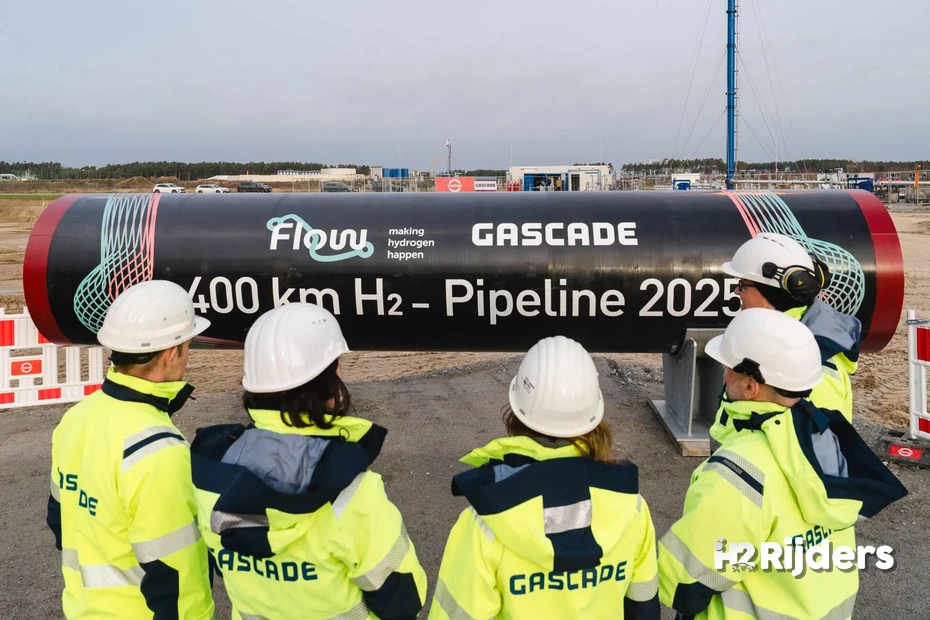
Demand for Germany's hydrogen network doubles: companies book nearly 6 gigawatts
The operators of Germany's hydrogen core network published their third market information package on 4 August. It shows that companies have now contractually reserved nearly 6 gigawatts of entry and exit capacity. On 13 May the figure was around half that.
These are paid reservations, not letters of intent. Parties are putting money on the table now to secure access to a pipeline network that has yet to be largely built. That makes it one of the most concrete signals so far that real demand exists in Germany for hydrogen delivered by pipe.
"The high demand for transport capacity and the associated willingness to pay are a strong signal for the ramp-up of the hydrogen economy," says Barbara Fischer, managing director of the industry association FNB Gas.
What has been booked
The figures are as of 23 July 2026. Alongside the nearly 6 gigawatts within the so-called clusters, around 0.6 gigawatts has been reserved for transport between clusters. Applications for a further 0.5 gigawatts are currently under review.
One detail matters: the reservations are spread across large parts of the network rather than concentrated in a single region. According to the operators, that confirms the network has been designed where demand actually sits.
To illustrate the scale: at full utilisation, 6 gigawatts works out at roughly 180 tonnes of hydrogen per hour — enough to fill some 4,500 truck tanks of 40 kilos every hour. That is a calculation based on the energy content of hydrogen rather than an operational forecast, but it gives a sense of the order of magnitude.
More demand than supply
At some points in the network, more applications came in than there was capacity on offer. An excess demand procedure was used, allowing the operators to process that additional demand after all. They are encouraging market parties to keep applying above the available volume — that is how it becomes visible where the network may later need reinforcing.
From now on the operators will publish this kind of market information at regular intervals, so project developers and offtakers can follow how demand develops.
The core network in figures
The Wasserstoff-Kernnetz is Germany's backbone network for hydrogen transport, approved by regulator Bundesnetzagentur in October 2024. It will run to over 9,000 kilometres of pipeline, of which roughly sixty percent consists of converted natural gas lines and forty percent is newly built.
The investment amounts to some 18.9 billion euros. Construction is phased: the first conversions started in 2025 and the whole network is due to be in place by 2032. It connects production sites, import terminals and large consumers, and links up with neighbouring countries' networks — including the Dutch one.
Why this matters for hydrogen drivers
A pipeline network may seem a long way from the refuelling nozzle, but it ultimately helps determine what hydrogen costs at the pump. Trailer delivery works fine to get started, yet per kilo it is considerably more expensive than moving hydrogen through a pipe. Once a station is connected to a pipeline, a sizeable chunk of that logistics cost disappears.
For international road transport there is a second point: Germany is the transit country par excellence. Corridors towards Poland, Austria and Scandinavia run straight through it, and a German network that connects to the Dutch one makes refuelling points along those routes far more logical to build.
In brief
- Third market information package from the German core network operators, published 4 August 2026
- Nearly 6 GW of entry and exit capacity contractually reserved within clusters (as of 23 July 2026) — double the figure since 13 May
- Around 0.6 GW reserved for transport between clusters; a further 0.5 GW applied for and under review
- These are paid reservations, not letters of intent
- An excess demand procedure was applied where demand exceeded supply
- Kernnetz: over 9,000 km, around 60 percent converted natural gas pipelines, 18.9 billion euro investment, complete in 2032
- Approved by the Bundesnetzagentur in October 2024
Sources
- Fuel Cells Works – Companies pay to reserve nearly 6GW on Germany's planned hydrogen backbone (4 August 2026)
- OGE / FNB Gas – Third market information package: reservations show significant demand along the hydrogen core network (4 August 2026)
- terranets bw – Reservierungen zeigen deutlichen Bedarf entlang des Wasserstoff-Kernnetzes
- gasworld – Nearly 6GW of capacity reserved for 9,000km German pipeline network, TSOs say
- Bundesnetzagentur – press release approving the Wasserstoff-Kernnetz (22 October 2024)


