
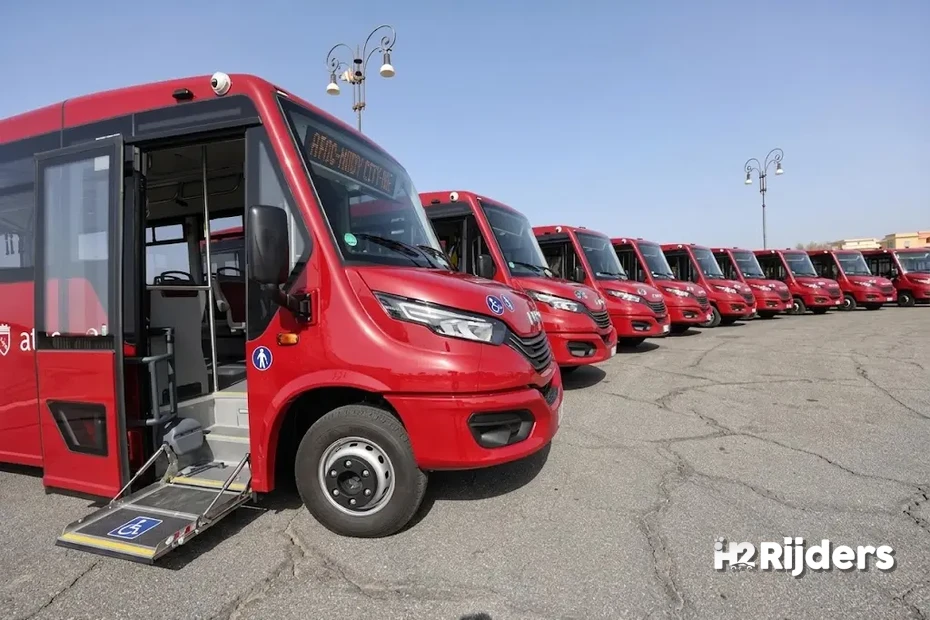
Rome will make its own hydrogen: €110 million for green buses and a production hub in Acilia
On 12 August 2026 Rome signed the agreement: over €110 million from Italy's Ministry of Infrastructure and Transport, channelled through the metropolitan authority to the city and managed directly by transport operator ATAC. The money is earmarked for new electric and hydrogen buses.
The most striking part of the plan is not in the buses but in the depot. The Acilia bus depot, in the south-west of the city towards the coast, will be converted into a green hydrogen hub: a plant producing hydrogen on site, plus a refuelling station that will also open to private vehicles. More than €6 million in European funding is available for it.
Make it yourself, then open the pump
Most transport operators switching to hydrogen buy their fuel from a gas supplier. Rome is reversing the order: make it first, then drive — and then open the pump to others.
Mobility councillor Eugenio Patanè calls the Acilia station "a model for green hydrogen production and charging". The depot design was developed by DIMA, the department of mechanical and aerospace engineering at Rome's Sapienza University.
That combination of own production and a publicly accessible pump is precisely what is missing elsewhere. A station with thirty buses guaranteed to fill up every day does not have to wait for enough private customers — and once it exists, those customers can use it.
Thirty buses towards the coast
In July 2026 ATAC confirmed the purchase of thirty hydrogen buses. They are intended for the link between the city centre and Ostia, the seaside district some thirty kilometres away.
That is a deliberate choice. Patanè points out that hydrogen is particularly useful for long connections such as the one between Ostia and Rome. A hydrogen bus covers 500 to 600 kilometres on a tank and refills in under twenty minutes — on a route run at high frequency all day, that counts.
The thirty buses are a small part of a much larger plan. Over the next ten years ATAC is investing €1.2 billion, including €420 million in 2026 alone, in 962 buses — 489 of them fully electric — plus 40 trams and 43 metro trains.
A plan that sat still for three years
The idea is not new. Patanè presented the plan for a €6 million hydrogen plant back in 2023, and in 2024 Sapienza joined for the technical design. Then it went quiet for roughly three years, until the project returned to ATAC's strategic plan this summer — this time with money attached.
Honesty is due: a signed agreement is not yet a bus on the road. No delivery date has been given for the thirty hydrogen buses, and the capacity of the Acilia electrolyser has not been made public either.
Italy is becoming Europe's hydrogen bus country
Rome is joining a development that has been under way in Italy for some time, and that is bigger than many people realise.
In Bologna, operator TPER runs 127 hydrogen buses, plus ten in Ferrara. They are Solaris Urbino 12 hydrogen models: a 70 kilowatt fuel cell, five roof tanks holding 37.5 kilos of hydrogen, and a range of over 350 kilometres. In practice in Ferrara they achieve fourteen to fifteen kilometres per kilo. The purchase cost €74.9 million, of which €69.9 million came from the European recovery fund. It was the largest European hydrogen bus tender to date, and is estimated to save 7,700 tonnes of CO2 a year. The hydrogen comes from Sapio; the refuelling stations are being built by TPH2, a joint venture of TPER and the Wolftank Group.
In Bolzano, five Caetano City Gold hydrogen buses entered service in spring 2026 alongside three electric Rampinis. Operator SASA is thereby growing to fifty electric and hydrogen buses, with another 120 on order.
Why the bus in particular
The city bus may be the easiest vehicle to put on hydrogen, and that has nothing to do with the bus itself but with its daily rhythm.
- It runs a fixed route and returns to its own depot every night. So one refuelling installation serves dozens of vehicles.
- It covers long daily distances, which is where range and short refuelling times genuinely pay off.
- The depot has space and its own connection, so you can produce on site — with solar on your own roof if you like.
That removes the chicken-and-egg problem that dogs hydrogen for passenger cars. And it is not a choice between technologies: Rome is simultaneously buying 489 fully electric buses. Batteries for the city routes, hydrogen for the long run to the sea. That also eases peak load on the depot's grid connection, since not everything has to charge at once overnight.
How we see it
This is how a hydrogen chain gets going in practice. Not with a motorway station hoping for customers, but with a fleet guaranteed to buy, production on the premises, and a pump that later opens to others as well.
That Italy is leading here is notable, and it shows the hydrogen ramp-up is not stalling everywhere equally. Alongside battery-electric transport, hydrogen is finding its place exactly where distance and availability decide the case. Now for the buses themselves — then Rome can show whether the plan delivers what it promises.
Sources
- Hydrogen Fuel News – Rome powers forward with green hydrogen hub at Acilia depot (17 August 2026)
- Il Faro Online – Bus green, Acilia diventa il polo dell'idrogeno (12 August 2026)
- Eco dalle Città – Roma, 110 milioni di euro ad Atac per bus elettrici e a idrogeno
- Roma Tomorrow – Roma conferma l'arrivo di 30 bus a idrogeno nella flotta Atac (17 July 2026)
- Abitare a Roma – Atac rispolvera il piano idrogeno
- Roma Capitale – Deposito Atac green, progetto a La Sapienza
- Sustainable Bus – First Solaris hydrogen buses delivered in Bologna
- TPER – I bus a idrogeno presto in servizio a Bologna
- ANSA and Autobusweb – new electric and hydrogen buses for SASA Bolzano, April 2026


