
After the fuel cell and the piston engine: Toyota patents a hydrogen gas turbine
On 22 June 2026 the US patent office published a Toyota application numbered US-20260168675-A1. Subject: a gas turbine combustor running on hydrogen. Not for a jet aircraft or a power station, but for small-scale work — the patent explicitly names outputs of 13 to 130 horsepower, roughly 10 to 95 kilowatts, in a simpler layout than a conventional turbine.
Toyota now has three ways on paper to turn hydrogen into motion: the fuel cell, the piston engine and the turbine.
What the patent describes
Hydrogen is awkward to burn in a turbine. The gas is far lighter than liquid hydrocarbons and burns at a higher temperature, so the familiar way of injecting and igniting fuel does not work well.
Toyota's solution centres on multiple injectors. Compressed air and hydrogen arrive through separate channels into a single nozzle, where they are thoroughly mixed before an igniter inside the injector lights the mixture. Using several such injectors keeps the mixture uniform throughout the combustor. That prevents locally rich pockets — exactly where nitrogen oxide emissions form — and limits dead space in the chamber, which is what makes such a turbine small enough for use in a vehicle.
Three routes, one molecule
Toyota has called its strategy multi-pathway for years: keep several technical routes open and let markets and infrastructure decide which wins where. With hydrogen that is clearly visible.
- The fuel cell, familiar from the Mirai. From 2026 Toyota introduces its third-generation fuel cell system, with up to twice the durability of the previous generation — comparable to a diesel engine — and around 20 percent more range.
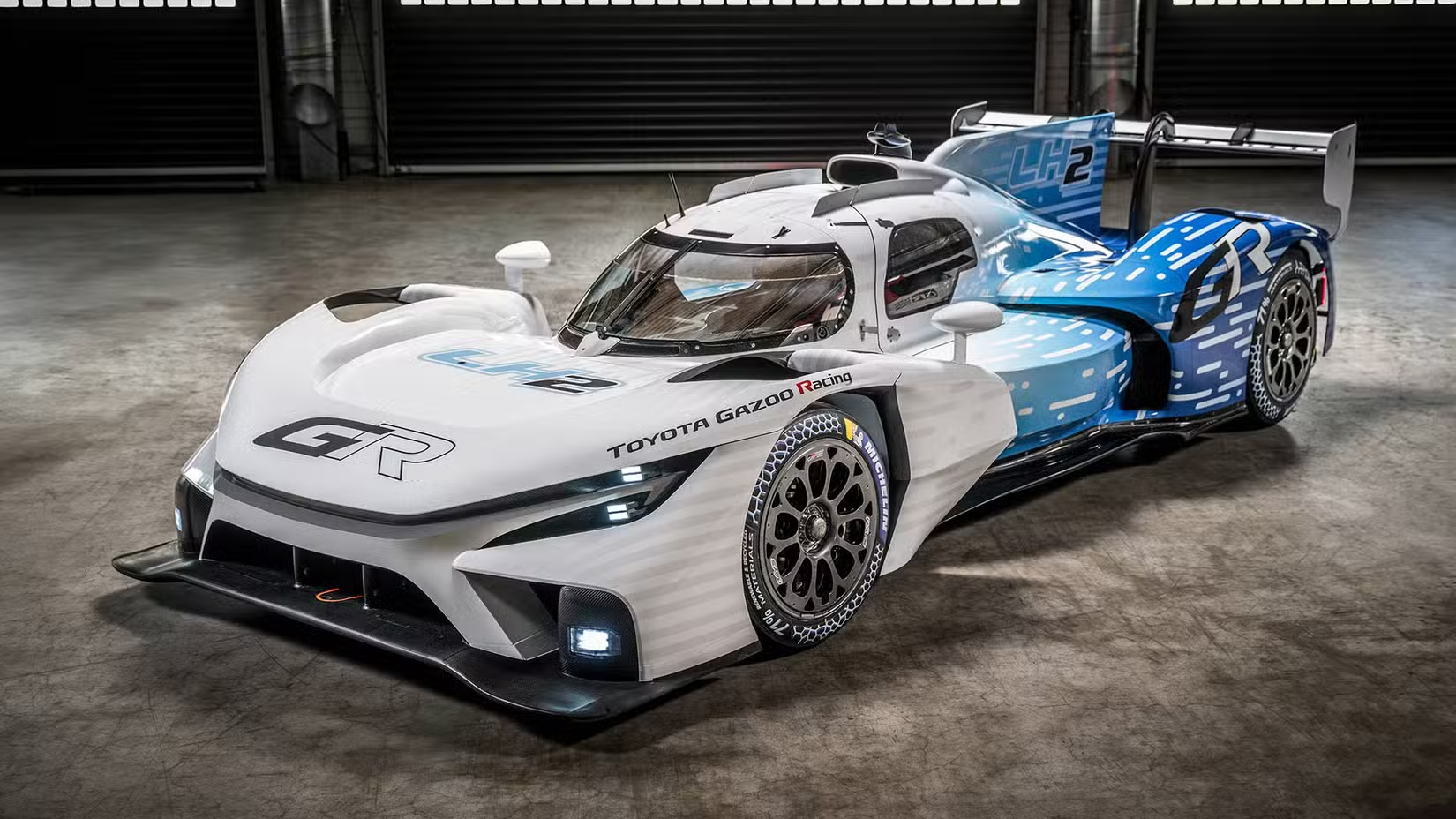
- The hydrogen piston engine, which the brand has been testing on track for years in the Super Taikyu series and showed in study models such as the Corolla Cross H2.
- And now the turbine.
Around that piston engine a series of patents has appeared in recent years, each solving one piece of the puzzle: water injection to cool the hotter-running combustion chamber, and an injector lubricated with silicone polymer instead of a flammable lubricant to prevent unwanted pre-ignition. The picture is of a manufacturer not making a single bet, but systematically clearing obstacles.
The turbine has had its chance before
A turbine in a car is not a new idea. Rover was driving one in 1950 with the JET1, and Chrysler went furthest in 1963: 55 Turbine Cars built, fifty of them loaned to 203 ordinary Americans in 133 cities. Together they covered more than 1.6 million kilometres.
The advantages were real. The turbine ran on diesel, petrol, kerosene and even jet fuel, had far fewer moving parts than a piston engine, needed little maintenance and started easily at minus thirty degrees. And still it disappeared. It responded slowly to the throttle, it was thirsty, it emitted too much nitrogen oxide and it was too expensive to build.
Why hydrogen could change the picture
The heart of that old problem: a turbine dislikes varying load. Accelerating, braking and accelerating again is precisely what it is bad at. Under constant load it is in its element.
That is what makes the power range in the patent interesting. Ten to ninety-five kilowatts is not a range for driving four wheels directly; it is the range of a generator. A small turbine producing electricity at one constant speed for a battery pack — a range extender, in other words — largely removes the technology's weakness while keeping its strengths: compact, light, few moving parts.
Hydrogen suits that well. In a turbine combustion is continuous, without pistons, valves and hot spots where hydrogen can ignite spontaneously. That happens to be one of the hardest issues with a hydrogen piston engine. What remains is nitrogen oxide, which forms in any high-temperature combustion — and that is exactly the problem Toyota tackles with uniform mixing.
What a patent does and does not say
Some sobriety is in order: a patent application is not a product announcement. Manufacturers constantly register ideas to protect intellectual property, and the vast majority never reach a showroom. There is no prototype in a hall and no model has been announced.
What a series of patents does reveal is direction. Toyota keeps investing consistently in every conceivable way of using hydrogen, and is now extending that to an engine type it had left alone until now.
Where such a turbine could end up
Large hydrogen turbines already exist: the power sector is working hard on gas turbines running on hydrogen. The trick Toyota is attempting is to make that technology small. Once that succeeds, more than one application appears: a range extender topping up a battery pack, a generator set on a building site without a grid connection, propulsion in shipping or in small aviation.
These are all places where laying a cable is difficult and where fast refuelling and low weight count heavily.
How we see it
To us this is above all a sign that the hydrogen story is broadening rather than narrowing. Fuel cell, piston engine and now a turbine: three very different machines, one and the same molecule underneath. What they share is that they all start with green hydrogen from an electrolyser.
Alongside battery-electric driving, that increases the number of routes to zero-emission mobility — which is exactly what a transition needs: not one solution that has to fit everywhere, but a toolbox with something for every job. Whether this turbine makes it, we will know in a few years. That Toyota takes it seriously enough to register it, we know now.
Sources
- GoCar.be – Derde keer goede keer? Toyota patenteert nu ook een turbinemotor op waterstof
- CarBuzz – Toyota, apparently bored with piston engines, now wants a hydrogen turbine (patent US-20260168675-A1, 22 June 2026)
- CarBuzz – Toyota's latest hydrogen engine patent reveals a simple solution to a tricky problem (injector patent, 11 April 2026)
- CarBuzz – Toyota files patent for water-cooled hydrogen combustion engine
- Toyota Global Newsroom – Toyota develops new fuel cell system (third-generation fuel cell)
- Toyota Global Newsroom – Hydrogen engine technology in the Super Taikyu Series
- Wikipedia – Chrysler Turbine Car; Rover JET1


