
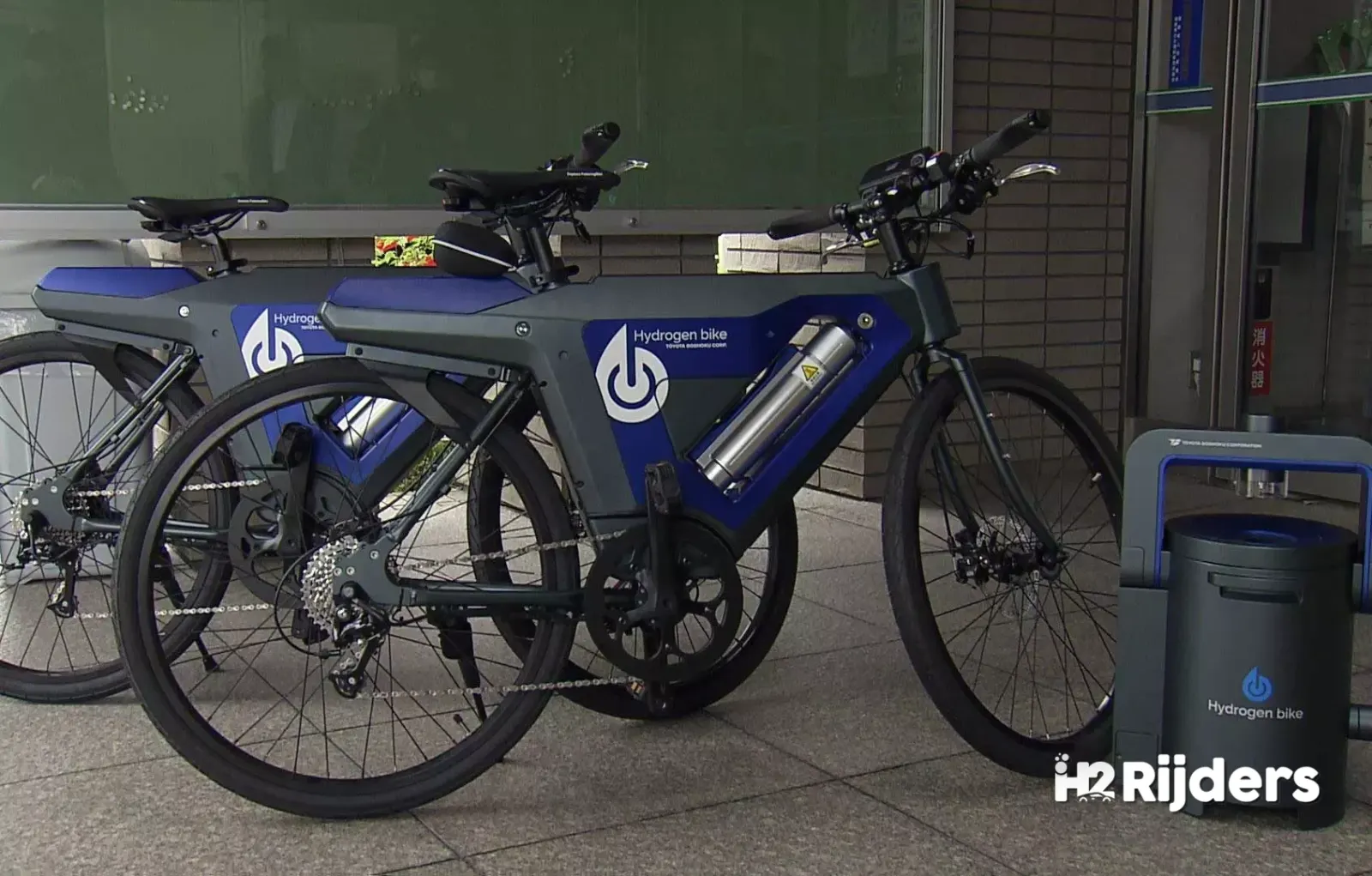
Free hydrogen bikes in Fukushima: Toyota Boshoku shrinks the Mirai fuel cell to palm size
Since 7 August 2026 you can borrow, free of charge, an electric bicycle in Namie in Japan's Fukushima prefecture that runs not on a battery but on hydrogen. Toyota Boshoku, the Toyota supplier that makes seats, interiors and filters, built a fuel cell system for it derived directly from the Toyota Mirai. One tank is good for around eighty kilometres of pedal assistance.
A fuel cell the size of a palm
The technology is not newly invented, it is shrunk. Toyota Boshoku uses the same precision-pressed titanium separators and ion exchanger as the Mirai's fuel cell, brought together in a stack that fits in the palm of a hand. Alongside it sits a small lithium-ion battery, not as the main source but to cover peaks: accelerating and climbing briefly demand more power than the fuel cell delivers.
A neat piece of design sits in the thermal management. Water circulates between the hydrogen tank and the fuel cell stack, so waste heat from the stack keeps the tank at temperature. As a result the system needs no radiator and no heater — two components you cannot easily fit on a bicycle.
The tank itself is roughly the size of a plastic bottle.
The most interesting number is the pressure
Hydrogen in a passenger car sits at 700 bar. In a truck usually at 350 bar. In this bicycle the tank sits below ten bar — under one megapascal.
That changes everything about cost and regulation. In Japan, hydrogen storage below one megapascal falls outside the permit requirements that apply to high-pressure systems. So no expensive high-pressure tank, no compressor, no special refuelling installation. Refilling takes about twenty minutes, but you can also simply swap the bottle — a matter of seconds.
In other words this is a very different product from the hydrogen mobility most people picture. Not a refuelling station chilling gas to minus forty degrees, but a small bottle in a bicycle frame.
Why Namie of all places
Namie is no random location. The town was fully evacuated after the March 2011 nuclear disaster and has been rebuilding itself around hydrogen ever since. On its edge stands the Fukushima Hydrogen Energy Research Field, at its 2020 opening one of the world's largest facilities for hydrogen from renewable energy: a ten megawatt electrolyser fed by a solar park, producing some 1,200 cubic metres of hydrogen per hour.
Toyota has been active there for years. Since 2022 a mobile shop has been running in Namie and neighbouring Futaba, powering its fridges and freezers from a fuel cell car — aimed at an ageing community where amenities are thin on the ground.
The bicycle followed that line. Toyota Boshoku began road trials in autumn 2024, and from 14 October to 23 November 2025 ran a first municipal trial in Namie together with Sumitomo Corporation — the first by a Japanese municipality, according to the town. The system was shown at the 2025 Japan Mobility Show. This month's free shared bicycles are the next step.
The contrast with Europe
The timing of this news is bittersweet. In March 2026 the French company Pragma Industries of Biarritz was placed into liquidation. Founded in 2004, it launched the Alpha in 2015: the world's first commercially sold electric bicycle with a fuel cell. Pragma supplied corporate fleets, bike-sharing systems and delivery services, and later expanded into cargo bikes.
According to Jean-Marc Remise, its industrial programmes director, the end came through commercial setbacks combined with a sharply deteriorated climate for the French hydrogen sector. More than twenty years of work fell away. Europe lost its pioneer in the same year Japan expanded the category.
What makes the Japanese approach different
Four differences stand out.
- The low pressure. Below ten bar the tank is cheap, permit-free and swappable. That largely removes the infrastructure question.
- The place. The bicycle runs on hydrogen made from sun and water a few kilometres away. It is not a standalone product but part of a town being organised around hydrogen.
- The backing. Toyota Boshoku is a large supplier with staying power, targeting market launch around 2030 — not revenue next quarter.
- The approach. It starts as a free service. That yields usage data and habit rather than pressure to sell bicycles immediately.
Where a hydrogen bicycle adds something
To be fair: for the average commuter an ordinary electric bicycle is simpler and cheaper, and that will remain so for now. The interesting applications lie elsewhere.
Think of fleets that must be continuously available: shared bicycles, delivery services, security patrols, rentals at tourist sites. There the problem is not range but charging time, and swapping a bottle takes seconds. In cold conditions, where batteries give up capacity, a fuel cell can also add value.
The system is clearly still developing, though. Quoted range varies: early trials spoke of thirty to fifty kilometres, now eighty, and the town of Namie cited around a hundred kilometres per full tank during its trial. That kind of spread comes with a technology still years from market.
How we see it
The value of this project lies not in the bicycle itself but in what it demonstrates: hydrogen does not automatically mean seven hundred bar and an expensive refuelling installation. Below ten bar, with a swappable bottle, an entirely different product category appears — closer to a camping gas canister than to a filling station.
Alongside battery-electric transport that widens the field again, now down to the lightest vehicle class there is. And there is something fitting in the fact that a town which had to be fully evacuated in 2011 is now testing what a hydrogen society looks like at the scale of a bicycle.
Sources
- H2-Mobile – Toyota miniaturise la pile hydrogène de la Mirai pour faire rouler des vélos
- Town of Namie – announcement of the hydrogen fuel cell bicycle trial (October 2025)
- Toyota Boshoku – Hydrogen Power System (product page)
- Newswitch / Nikkan Kogyo Shimbun – specifications of the Toyota Boshoku FC assist bicycle
- Motor-Fan – Toyota Boshoku at the Japan Mobility Show 2025
- Toyota Global Newsroom – Commencing social implementation of hydrogen in Fukushima
- NEDO – Fukushima Hydrogen Energy Research Field (FH2R)
- H2-Mobile, Cleanrider and Bike Europe – liquidation of Pragma Industries, March 2026


