
Petrol from air and water: what is really happening in Japan — and why hydrogen is the pivot
An appealing post is circulating on LinkedIn: Japan is turning air, water and renewable electricity into fuel that runs in existing engines without modification. Broadly, that is true. But the full story is less linear — and more instructive because of it. It involves a pilot plant in Yokohama, a pause, a German supplier, and green hydrogen as the constant.
What Japan actually built
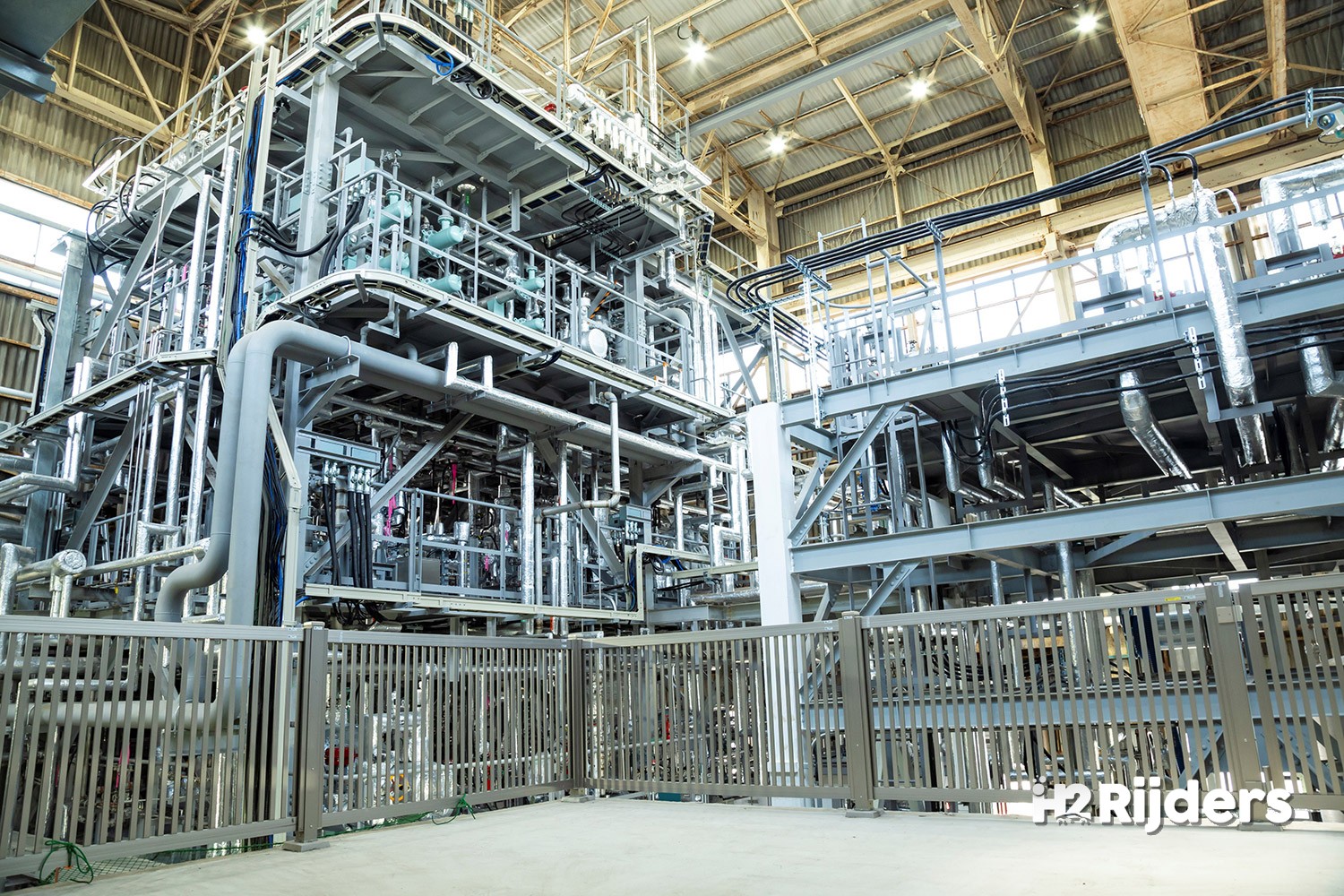
In September 2024 ENEOS, Japan's largest energy company, started up the country's first integrated synthetic fuel demonstration plant at its research laboratory in Yokohama. Integrated here means every step on one site. Renewable electricity splits water into hydrogen and oxygen. That hydrogen, together with captured CO2 — from industrial flue gases or directly from the air — goes into a Fischer-Tropsch reactor, which yields liquid hydrocarbons: petrol, diesel and jet fuel.
The scale is modest: roughly one barrel a day, about 159 litres. That is not production, it is learning. The fuel was used at the Expo 2025 world exposition in Osaka, in shuttle buses and passenger cars. The project has run since April 2022 under NEDO's Green Innovation Fund, with ten years of government support and the goal of establishing efficient, large-scale production technology before 2030.
The technology itself is not new. The Fischer-Tropsch process dates from the 1920s, and ENEOS builds on the JAPAN-GTL consortium, which ran a 500 barrel-per-day demonstration plant between 2009 and 2011. What is new is the feedstock: not natural gas or coal, but water, CO2 and renewable power.
Why Japan in particular
The driver is not primarily climate, but security of supply. Japan imports well over 99 percent of its oil and reached an energy self-sufficiency rate of 16.4 percent in fiscal 2024. A country that imports almost all of its liquid fuel looks differently at a fuel whose raw materials are air, water and sunlight.
On top of that, synthetic fuel is a drop-in: existing engines, existing tankers, existing pumps. For a country with a large vehicle fleet and a strong car industry, that is attractive. Idemitsu Kosan, ENEOS, Toyota and Mitsubishi Heavy Industries are jointly studying how carbon-neutral fuels — both e-fuels and biofuels — can be introduced in Japan around 2030.
The part that usually gets left out
In October 2025 the next step was put on hold. ENEOS postponed construction of a planned pilot plant indefinitely and shifted its focus to biofuels. The reason was not the chemistry but the arithmetic: green hydrogen, electrolysers, direct air capture and renewable power together remain too expensive to compete with fossil petrol. The fuel works; the price does not yet.
That is not a failure, but it is a nuance missing from many enthusiastic posts. Sharing the Japanese breakthrough without this chapter tells only half the story.
And yet it continues — via Germany
Because in July 2026 came another turn. ENEOS signed an offtake agreement with German eFuel One (GEF1) of Hoya, which operates Germany's first commercial eGasoline plant. GEF1 uses CAC Engineering's MethaFuel technology: green hydrogen plus recycled CO2 converted into synthetic hydrocarbons. It is ENEOS's first import of synthetic fuel, and GEF1's first offtake partner outside Europe.
So the strategy has shifted rather than been abandoned: do not produce where electricity is expensive, buy where it is cheaper, and meanwhile build the market, the rules and the logistics at home.
Hydrogen is the pivot in every scenario
Place the Japanese approach beside the European one and one thing stands out: whichever way you turn it, the electrolyser comes first. If a car runs on a fuel cell, the hydrogen goes straight into the tank. If it runs on a hydrogen combustion engine, the same applies. And if you turn it into synthetic petrol, that same green hydrogen is the feedstock to which carbon is added.
That makes e-fuels not a competitor to hydrogen mobility but a second market for the same green hydrogen. Every electrolyser built anywhere serves both routes. We saw the same pattern at Shell, Repsol, Zero Petroleum and Bosch: hydrogen breaks out of the car tank and becomes the basis of liquid fuel.
Where synthetic fuel delivers most
Honesty matters here. The route from power to hydrogen to hydrocarbon to combustion costs energy at every step; well-to-wheel efficiency is on the order of ten to fifteen percent. So the logical first destination for e-fuels is not the average commuter, but what is hard to electrify: aviation, shipping, and the existing global fleet of well over a billion vehicles that will not replace itself.
And the loop only closes under conditions. The CO2 leaving the tailpipe has to be the CO2 previously taken from the air or a chimney, and the electricity has to be green. That is a demanding requirement — and precisely what the Japanese approach is aiming at.
How we read it
The Japanese story is less spectacular than the LinkedIn version and more interesting than the scepticism. There is a working installation, there was a brake on scaling up, and since this summer there is an international supply chain. That is how energy transitions go: in fits and starts, with players changing roles along the way.
For us the core point is that green hydrogen is bigger than the tank of a single car. The same molecule that feeds a fuel cell may soon fly an aircraft and run an existing engine. Alongside battery-electric driving, that widens the number of routes to zero-emission mobility — which is exactly what a transition needs.
Sources
- ENEOS Holdings – Synthetic Fuels (innovation page)
- ENEOS – Completion of Japan's first synthetic fuels demonstration plant (30 September 2024)
- F&L Asia – ENEOS completes Japan's first integrated synthetic fuel production plant
- ENEOS – ENEOS and German eFuel One launch strategic cooperation in synthetic fuels (17 July 2026)
- German eFuel One / eFuels Forum – strategic cooperation with ENEOS
- Argus Media – Japan's Eneos halts CO2-based fuel to focus on biofuel
- Quantum Commodity Intelligence – Eneos pivots away from e-fuel to focus on biofuels due to high costs (10 October 2025)
- Mitsubishi Heavy Industries / Toyota – Idemitsu Kosan, ENEOS, Toyota and MHI commence study toward introduction and spread of carbon-neutral fuels for automobiles
- NEDO – Green Innovation Fund
- METI / OpenGov Japan – Japanese energy self-sufficiency and oil import dependency


